
Your member already got the loan, just not from you.
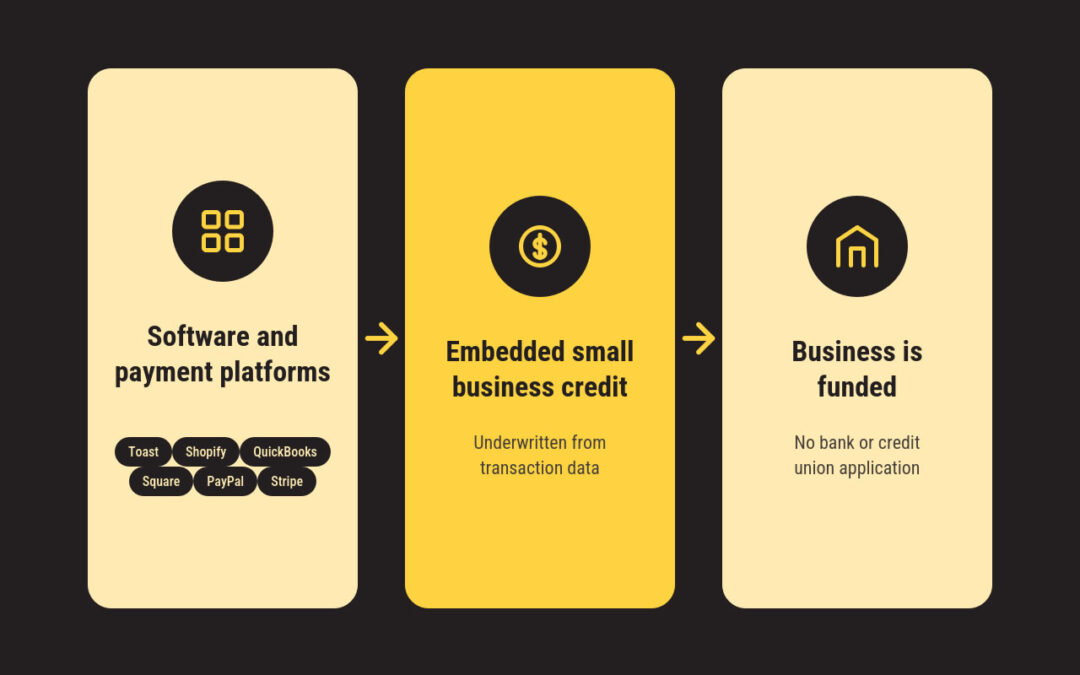
Increasingly, that’s because the credit relationship already happened elsewhere: inside the point-of-sale system, accounting software, or payment processor the member uses every day.
This is embedded small business lending, changing who originates the relationship before a credit union ever enters the picture.
How the Model Works
Companies such as Toast (restaurant POS), Shopify (e-commerce), QuickBooks (accounting), Square (POS and payments), PayPal (payments), Stripe (payments infrastructure), Gusto (HR and payroll), and ServiceTitan (contractor and field service) all sit on transaction data most lenders never see, and several have added credit on top of it.
Toast Capital and QuickBooks Capital loans, for example, are issued by WebBank, not Toast or Intuit. The platform owns the application flow. A chartered bank owns the balance sheet. Some, like Stripe, white-label the infrastructure entirely, which is how Parafin ends up behind Gusto’s credit line and Amazon’s seller financing. Others, like ServiceTitan, underwrite nothing and simply route members to outside lenders.
What This Means for Your Portfolio
The scale is no longer marginal. Square has originated more than $32 billion in U.S. small business loans since 2014, with an average loan size near $10,000. PayPal has surpassed $30 billion in cumulative global small business loan originations since 2013. Intuit reported U.S. QuickBooks Capital loan volume grew 54% to $1.9 billion in a single quarter of fiscal 2026. Shopify’s own SEC filings show it purchased $4.2 billion in merchant cash advances and loans across its eight-country footprint in 2025, up from $3 billion the year before.
Many of these borrowers likely never applied at a credit union, and that borrowing leaves no trace in your portfolio data.
Shopify’s newer Capital Flex product ties borrowing capacity to ongoing performance, a structure built to expand credit for proven merchants over time. Borrowing capacity here isn’t capped; it’s designed to climb.
This shift is reshaping how small business owners think about their own capital options too, a theme we track closely in our Becoming Bankable research.
What Strategic Credit Unions Should Be Doing
The vulnerability sits in a specific range. Square’s average loan is near $10,000; most Shopify offers reportedly land between $5,000 and $200,000, funded in days with no traditional underwriting. Whether members would turn to their credit union first for financing in that range, or already assume it’s not worth the wait, is exactly the kind of question the renewal conversation below is meant to answer.
Two paths follow, on different timelines.
Short term, start asking directly during renewals whether a member has used embedded financing, a data point your portfolio can’t surface on its own, and it costs nothing to begin.
Long term, consider building the capacity to compete on speed, and that doesn’t mean building alone. Multi-investor commercial lending CUSOs already exist to pool underwriting expertise and compliance infrastructure, the same model behind a reported 35% rise in credit union commercial lending over the past year, according to Callahan & Associates. That shared infrastructure is where the capability to compete on speed would be built, not from scratch inside any one credit union.
Ask first, and a visibility gap becomes a membership and portfolio pipeline.