
In the U.S. Chamber of Commerce’s Q3 2026 Small Business Index published at the end of September, 71% of owners rate their business health as good, and 72% are comfortable with their cash flow. Small business owners are not describing weak businesses. At the same time, 54% name inflation as a top challenge, more than double the 24% who cite revenue.
Both can be true. A business can be growing and still be getting financially weaker.
What a margin squeeze looks like
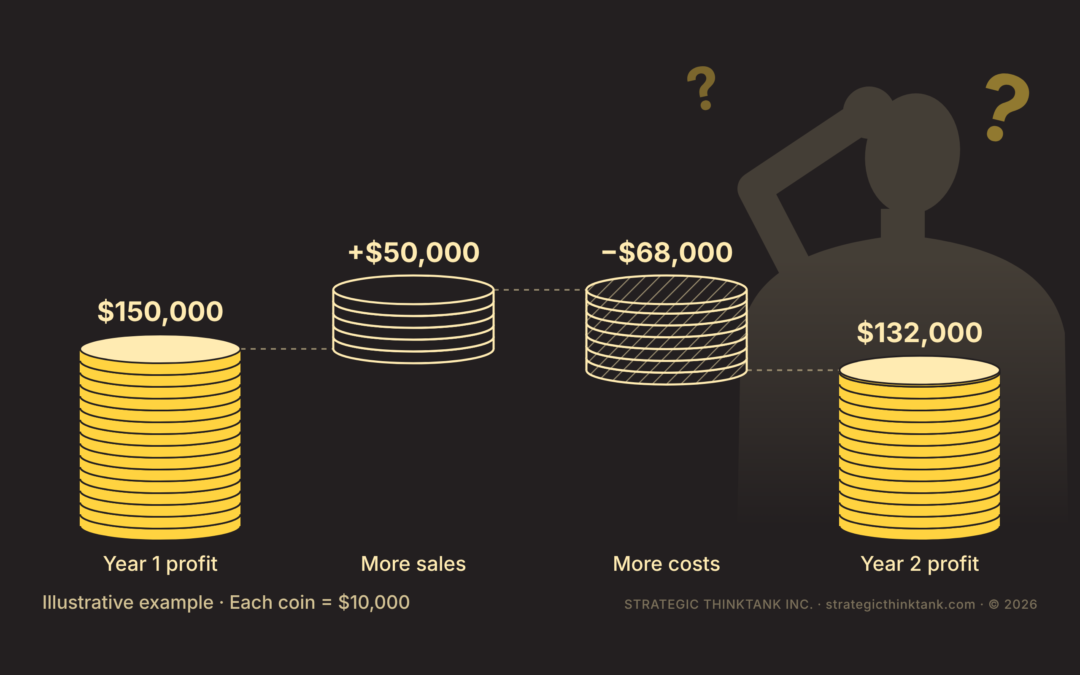
Take an illustrative business with $1 million in sales, $850,000 in total costs, and $150,000 in profit. Sales grow 5% on higher volume at unchanged prices. Costs rise 8% to $918,000: about 5% from added volume and 3% from higher supplier prices. Sales are up $50,000, yet profit falls to $132,000, a 12% drop in a year the business grew.
That squeeze moves down the chain from revenue to gross profit, operating profit, and cash flow, and finally to the cash available for loan payments, the figure lenders examine. For context, consumer prices rose 3.4% over the 12 months ending in August, according to the Bureau of Labor Statistics. That index tracks consumer prices, not business costs, but it frames the environment.
Temporary cost or permanent change?
Owners can raise prices, accept thinner margins, cut expenses, renegotiate supplier terms, improve productivity, or borrow. Each has consequences, so the first question is which cost increases are temporary and which are here to stay. Our 2025 look at rising costs by industry showed how unevenly the squeeze lands. Try this: list your five largest expenses, note how much each rose, and how much you can pass on to customers. Costs you cannot pass on need a lasting fix, not another month of absorbing them.
What financing can and cannot fix
Financing helps when it solves a timing or capacity problem: a line of credit that covers a predictable gap between paying suppliers and getting paid, equipment that lowers production costs, or inventory for confirmed, profitable demand. It cannot solve a profitability problem. Borrowing repeatedly to cover payroll shortfalls, operating losses, unprofitable customers, or refinancing without fixing the cause leaves the underlying gap in place. A lender asks whether the business can repay the loan. The owner should also ask whether the loan will make the business stronger.
Stress-test before you borrow
Ask four questions. What if costs rise another 5%? What if revenue lands 10% below projection? What if customers take longer to pay? Can the business still make the loan payment? Gross margin, operating cash flow, and the cash left for loan payments supply the answers, and a strong borrower knows them before the lender asks.
When costs rise, the first question is not where to find money but what is happening to your margins and cash flow.
Become bankable before you borrow
Being bankable is not just qualifying for financing. It is knowing your business is ready to use it well. Our Becoming Bankable® program helps owners get there before they borrow. Learn more, or book a free discovery session.